Candy Casino complaints and reputation: what the current record shows
 Available in AU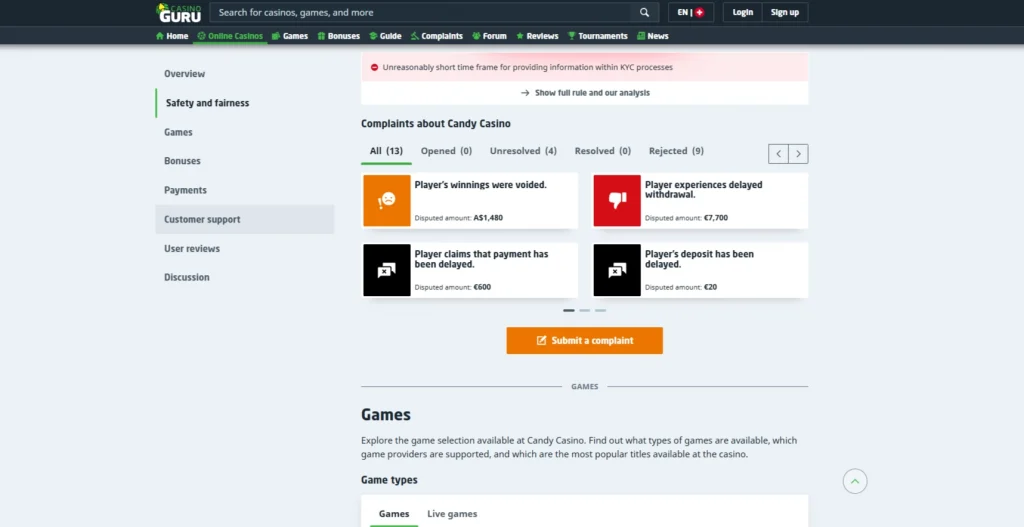
Candy Casino complaints
The current public record contains negative reputation signals, but they need to be read with attribution and scale. Trustpilot showed a 2.2/5 TrustScore from only 11 reviews when checked on 17 September 2026. Casino Guru’s complaint-status table showed 13 records: 4 unresolved, 9 rejected, 0 resolved and 0 opened. One unresolved case concerns an Australian player and a disputed A$1,480 withdrawal.
Those figures do not prove that every allegation is correct, nor do they justify labelling the casino a scam. They show where complaints have clustered and which disputes remained unresolved in third-party processes. The useful question is not whether one rating is good or bad, but whether recent cases repeat the same themes and whether those themes line up with documented account, bonus and withdrawal rules.
Reputation snapshot
Table of Contents
- Two review platforms show different kinds of evidence
- A complaint count is less useful without the outcome labels
- The July 2026 A,480 withdrawal dispute remains unresolved on Casino Guru
- Withdrawal, verification and bonus-rule friction deserve separate checks
- Current Candy terms provide a direct complaints channel and cashout rules
- User reviews are most useful when they contain dates, amounts and checkable details
- Third-party complaint pages can contain licensing details that age faster than the complaint itself
- Use repetition, recency and documentary support before drawing a reputation conclusion
- How to read Candy Casino complaint patterns before depositing
- Recommend
Two review platforms show different kinds of evidence
Trustpilot’s Candy Casino profile is a small user-review sample. In the 17 September 2026 check it displayed 11 reviews and a 2.2/5 TrustScore. Trustpilot also states that reviews are the opinions of individual users and notes that the company has not invited customers to review, so the sample may not be representative.
Casino Guru is different. Its complaint section tracks cases through a complaint-resolution process and assigns statuses such as unresolved or rejected. Its current status table totals 13 complaint records, with 4 unresolved and 9 rejected. Those labels describe Casino Guru’s case handling and database, not a court, regulator or independent legal finding.
Status matters
A complaint count is less useful without the outcome labels
A headline number can easily mislead. Thirteen records does not mean thirteen current unresolved disputes. Casino Guru’s current table separates the set into 4 unresolved and 9 rejected cases, with none marked resolved or opened at the time of checking. That distribution is more informative than repeating the total alone.
| Signal | Value checked 17 September 2026 | What it can tell you | What it cannot prove |
|---|---|---|---|
| Trustpilot TrustScore | 2.2/5 from 11 reviews | Small-sample user sentiment | Whether each allegation is accurate |
| Casino Guru total records | 13 | Volume of complaint records in its status table | That all 13 were upheld |
| Unresolved | 4 | Cases the third-party process did not close with a resolution | A regulatory finding of wrongdoing |
| Rejected | 9 | Cases Casino Guru classified as rejected | A general verdict about every player experience |
The small Trustpilot sample also deserves caution in the other direction. A low score from 11 users is a reputation signal, but it is not equivalent to a large representative customer survey. The most useful reading combines the score with dated case records, operator terms and evidence of whether similar themes recur.
Australian complaint record
The July 2026 A$1,480 withdrawal dispute remains unresolved on Casino Guru
A Casino Guru complaint submitted on 8 July 2026 records an Australian player’s dispute over a withdrawal with a listed amount of A$1,480. Casino Guru’s summary says the player reported that a withdrawal was rejected and the balance reduced after Candy Casino relied on a bonus-related rule. The player disputed how that rule had been applied.
Casino Guru says it contacted the casino, received no response in its process and marked the case unresolved on 29 July 2026. That is the third-party case record. It should not be rewritten as a proven finding that the casino unlawfully confiscated money, because the underlying allegation was not independently adjudicated on that page.
What is established and what is only alleged
Established from the complaint page: the case exists, the player was identified as being in Australia, the listed amount is A$1,480, and Casino Guru marked it unresolved after reporting no operator response. The player’s account of how the bonus rule was applied remains an allegation within that complaint record.
Recurring themes
Withdrawal, verification and bonus-rule friction deserve separate checks
Across the public review material, three themes appear repeatedly enough to merit attention: withdrawal disputes, verification friction and disagreements about bonus rules. They should not be collapsed into one accusation. Each theme has a different factual test.
For withdrawals, the first check is the operator’s published process. Candy’s current terms say no withdrawal is processed until the account is fully verified. The separate withdrawal rules page explains that condition and other documented cashout requirements without turning individual complaints into general facts.
For verification, distinguish delay or frustration reported by a reviewer from the actual KYC rule. Candy’s current terms and AML policy support the fact that KYC can be required, and the terms state that withdrawals wait until full verification. The KYC verification page covers the operator’s documented process and which details are confirmed by primary sources.
Bonus disputes require another layer. A complaint can be genuine as a report of a player’s experience while the contractual question still depends on the exact promotion and terms that applied at the time. That is why a complaint page should never substitute a reviewer’s wording for the current bonus rules.
Primary-source cross-check
Current Candy terms provide a direct complaints channel and cashout rules
Candy’s current Terms and Conditions say complaints can be sent to [email protected]. The same terms state that no withdrawals are processed until the account is fully verified. These primary-source rules do not resolve any historical dispute by themselves, but they provide the baseline against which a complaint about support, verification or withdrawal handling can be assessed.
The terms also currently list Australia and its territories as restricted. That matters when reading any Australian complaint because country eligibility is a separate issue from whether a specific withdrawal or bonus dispute was handled correctly. The licence and Australian status page explains the current jurisdictional position without duplicating the complaint evidence here.
Reading user reviews
User reviews are most useful when they contain dates, amounts and checkable details
Review platforms are useful for spotting possible patterns, but the quality of individual posts varies. A short one-star statement with no dates, transaction amount or description of the operator’s response carries less evidentiary weight than a detailed complaint with a timeline and a visible case status. The same principle applies to positive reviews: a five-star rating without detail is not proof that every withdrawal is smooth.
For practical assessment, prioritise recent reports that identify the stage where the issue arose, such as account verification, bonus conversion or withdrawal review. Then compare the allegation with the operator’s current terms and with other independent records. If several dated complaints describe the same mechanism, that pattern is more informative than a single dramatic post.
It is also worth checking whether the operator replied. A documented response can clarify which rule was applied, whether evidence was requested and whether the dispute later changed status. In the Australian A$1,480 case, Casino Guru’s unresolved classification specifically records that it did not receive a casino response in its process. That absence is relevant to the case outcome, but it still does not prove the player’s entire version of events.
Freshness warning
Third-party complaint pages can contain licensing details that age faster than the complaint itself
The Australian complaint page says Casino Guru considered Candy Casino to be operating without a valid licence when it closed that case. The Curaçao Gaming Authority currently shows an active certificate for candy.casino. These are separate, dated records and should be read in their respective time contexts.
The complaint’s status remains a third-party record of an unresolved dispute. The current licensing position is a separate primary-source fact. This is a useful example of why reputation checks need timestamps: a complaint can remain relevant even after another factual field on the same third-party page becomes stale or conflicts with a newer regulator source.
Evidence-weighted method
Use repetition, recency and documentary support before drawing a reputation conclusion
A practical complaint review can be reduced to five checks. First, note the date and whether the case is still current. Second, separate allegations from the platform’s own documented actions, such as contact attempts and status changes. Third, look for repetition across independent users rather than treating one complaint as universal. Fourth, compare the disputed issue with current primary-source terms. Fifth, keep jurisdiction and licence facts separate from service-quality allegations.
That method also helps when reviewing payment methods. A payment option being listed does not prove a specific withdrawal will be approved, just as a complaint about one cashout does not prove that every cashout fails. The evidence should stay attached to the exact claim it supports.
For the broader feature and access picture, the Candy Casino Australia review brings together games, payments, promotions, account rules and the Australian restriction without turning review-platform sentiment into a site-wide verdict.
Before depositing
How to read Candy Casino complaint patterns before depositing
The current record gives Australian readers reasons to examine the terms closely: Trustpilot has a low score from a very small sample, Casino Guru’s complaint table includes four unresolved records, and the July 2026 Australian A$1,480 dispute remains unresolved in that third-party process. None of those points, alone or together, proves every allegation or supports calling the casino a scam. The stronger approach is to treat them as dated risk signals, then cross-check the exact withdrawal, KYC, bonus and country rules that would apply to your account. Because Candy’s current terms list Australia as restricted, that eligibility issue should be resolved before any deposit decision is considered.
Recommend

Candy Casino licence, safety and legal status for Australian readers
Candy Casino Australia Guide Candy Casino licence Australia Candy Casino is operated by WoT N.V.,...

Candy Casino registration in Australia: sign-up signals vs official restrictions
Candy Casino Australia Guide Candy Casino registration Australia Candy Casino's current Terms and Conditions list...

Candy Casino bonuses in Australia: offers exist, eligibility is the first check
Candy Casino Australia Guide Candy Casino bonuses Candy Casino currently advertises a registration offer of...

Candy Casino games and providers: a broad lobby without a trustworthy fixed game count
Candy Casino Australia Guide Candy Casino games Candy Casino's current lobby exposes slots and top...

Candy Casino payment methods for Australia: AUD is a signal, not an eligibility guarantee
Candy Casino Australia Guide Candy Casino payments Current published sources confirm an AUD account-currency signal...