Candy Casino KYC: documents, verification and withdrawal checks
 Available in AU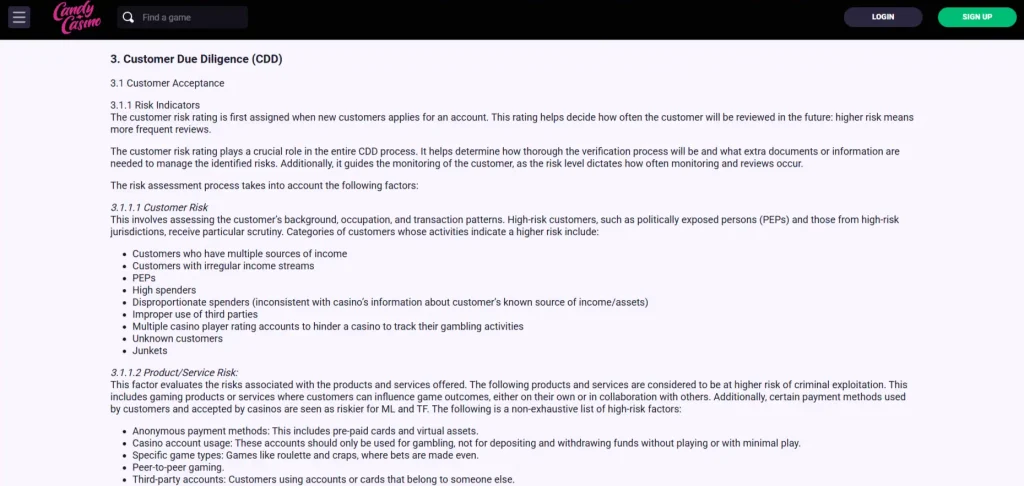
Candy Casino KYC
Candy Casino can conduct identity verification, and its current Terms and Conditions state that withdrawals are not processed until an account is fully verified. The same terms say document verification can take up to 24 hours from submission of the last document. That timing is a review window, not a promise that a withdrawal will be approved or paid within 24 hours.
The operator’s current KYC wording gives examples rather than one fixed checklist for every customer. Passport or ID, a selfie with a document and, for some card deposits, card-copy checks are specifically listed. Candy’s AML policy also explains that customer due diligence can vary with risk and payment circumstances.
What the operator can check
Table of Contents
- Candy Casino KYC is broader than the registration form
- The current terms list KYC examples, not a universal document bundle
- Profile information and verification evidence are two different layers
- Candy Casino links full verification directly to withdrawal processing
- The published 24-hour figure starts after the last document is submitted
- Card deposits can create an extra ownership check
- KYC completion does not settle Australian service eligibility
- Keep the document request, submission time and support record together
- How Candy Casino verification can affect withdrawals
- Recommend
Candy Casino KYC is broader than the registration form
The current Candy Casino Terms and Conditions say the administration may conduct KYC at any time. The examples in the published terms include a passport or ID, a selfie with a document and, when a deposit is made by credit card, copies of card details with specified masking.
The current AML policy describes the wider customer due diligence framework. It says identification can be verified using reliable independent documents, data or information and that government-issued photo identification is treated as reliable evidence of identity. It also says the scope of verification can vary depending on the risk of the customer relationship.
Document examples
The current terms list KYC examples, not a universal document bundle
There is a useful distinction between the documents Candy names publicly and the documents any one customer will actually be asked to provide. The terms say KYC can include a passport or ID and a selfie with a document. They also describe card-copy checks for card deposits. These are current examples, but the wording does not establish that every customer will always receive the same request.
The AML policy reinforces that case-by-case approach. It describes customer due diligence and risk assessment, including the possibility of stronger verification where the relationship or transaction creates additional risk. It also states that only government-issued documents containing a photograph are treated as reliable for verifying identity, while some government documents without a photograph can be used to confirm a current address if the address is shown.
| Verification item | What the current official text supports | Practical reading |
|---|---|---|
| Identity document | Passport or ID is listed as a KYC example. | Expect identity evidence to be central to verification. |
| Selfie | A selfie with a document is listed as a possible KYC check. | Identity ownership can be checked in addition to document details. |
| Payment card | Card-copy checks can be requested for card deposits. | The payment method can affect what evidence is requested. |
| Address evidence | The AML policy describes government documents that can confirm an address. | Address checks are part of the broader due diligence framework. |
A rigid checklist would therefore be misleading. The strongest approach is to prepare accurate account information and respond to the actual request shown in the account or sent through the operator’s verified support channel.
Registration data
Profile information and verification evidence are two different layers
Candy’s AML policy describes a full customer profile at registration, including identity and contact information. That registration data is not the same thing as a completed KYC review. A person can enter profile details first and still be asked to substantiate those details later with documents.
This distinction matters because the registration status already shows a separate Australia access conflict. Candy’s current terms list Australia and its territories as restricted, even though a June 2026 Australian test reported operational sign-up signals. KYC does not resolve that country-rule conflict. Passing identity checks would only establish that the account holder has satisfied the verification steps requested by the operator.
KYC is not an eligibility override
Identity verification can confirm who controls an account. It does not cancel the current restricted-country clause or change country eligibility.
Withdrawal checkpoint
Candy Casino links full verification directly to withdrawal processing
The current terms are explicit on the sequence: until the account is fully verified, no withdrawals are processed. That makes KYC a practical cashout checkpoint rather than an optional profile exercise. It also means a quick registration or deposit experience should not be used to predict how a later withdrawal will proceed.
The separate cashout checks page explains the other payout conditions. For KYC purposes, the important point is narrower: a withdrawal request can remain unprocessed while verification is incomplete, and completion of verification does not by itself guarantee that every other withdrawal condition has been met.
The same official terms connect deposits and withdrawals to personal payment details. The name on the credit card or payment account used for a deposit or payout must correspond to the name registered on the player account. That is why payment ownership and identity data should be consistent from the beginning rather than treated as details to correct at cashout.
Verification timing
The published 24-hour figure starts after the last document is submitted
Candy’s current terms state that verification of documents takes up to 24 hours from submission of the last document. The phrase “last document” is important. If the operator asks for another item after an incomplete submission, the published window is tied to the later submission point rather than the moment the first file was uploaded.
This figure should not be merged with withdrawal processing time. It describes document verification. A payout can still depend on other account, payment or terms checks after KYC is complete. Treating “up to 24 hours” as a cashout guarantee would collapse two separate processes into one. The timing also makes completeness important: the published review window starts after the last document is submitted, so an additional document request changes the relevant starting point.
Card verification
Card deposits can create an extra ownership check
The current terms say card deposits can trigger a request for card images and describe which digits should remain visible and that the CVV2 code should be hidden. The underlying purpose is consistent with the wider KYC rule: the operator wants to connect the payment instrument to the verified account holder.
This is one reason the Candy Casino Australia review keeps payment availability and verification requirements separate. A card being technically supported does not mean every card deposit will move through the account without an ownership check.
Do not send documents to unverified contacts or publish card images openly. The operator’s current official pages identify its own support channels and account procedures; KYC material should stay within those official channels rather than being shared with unrelated third parties.
Regulatory context
KYC completion does not settle Australian service eligibility
Candy Casino is operated by WoT N.V. and applies customer due-diligence requirements under its published policies. The wider licensing and regulatory context is covered on the licence and regulatory context page.
For an Australian reader, there are two separate questions: whether the operator can verify the identity of an account holder, and whether the service is permitted to be offered to people in Australia. Successful KYC only answers the first question. Candy’s current terms still list Australia and its territories as restricted.
When verification becomes a dispute
Keep the document request, submission time and support record together
If verification stalls, the most useful record is a simple chronology: what was requested, when each document was submitted, whether another item was requested and what the support team said. That record is more useful than assuming the 24-hour wording means every case must be completed within exactly one day.
The complaint patterns page deals with disputes more broadly. On a KYC issue, preserve the exact request and any response from official support, because identity and withdrawal complaints often turn on the sequence of account checks rather than on one isolated screen record.
For an Australian account, the current country restriction is an additional issue that should not be hidden behind a document dispute. A verification complaint and an eligibility problem can exist at the same time, and resolving one does not automatically resolve the other.
Practical KYC reading
How Candy Casino verification can affect withdrawals
Candy Casino’s current rules make verification a direct prerequisite for withdrawal processing, while the document request itself can vary by identity, payment method and risk. The official terms currently give an up-to-24-hour document-review window from the final submission, but that is not a withdrawal guarantee. Accurate profile data and matching payment ownership reduce avoidable inconsistencies, yet KYC completion does not override the separate Australia restriction. For Australian readers, the safest interpretation is to keep identity verification, withdrawal eligibility and country eligibility as three distinct checks.
Recommend

Candy Casino licence, safety and legal status for Australian readers
Candy Casino Australia Guide Candy Casino licence Australia Candy Casino is operated by WoT N.V.,...

Candy Casino registration in Australia: sign-up signals vs official restrictions
Candy Casino Australia Guide Candy Casino registration Australia Candy Casino's current Terms and Conditions list...

Candy Casino bonuses in Australia: offers exist, eligibility is the first check
Candy Casino Australia Guide Candy Casino bonuses Candy Casino currently advertises a registration offer of...

Candy Casino games and providers: a broad lobby without a trustworthy fixed game count
Candy Casino Australia Guide Candy Casino games Candy Casino's current lobby exposes slots and top...

Candy Casino payment methods for Australia: AUD is a signal, not an eligibility guarantee
Candy Casino Australia Guide Candy Casino payments Current published sources confirm an AUD account-currency signal...